How to wrap a pallet
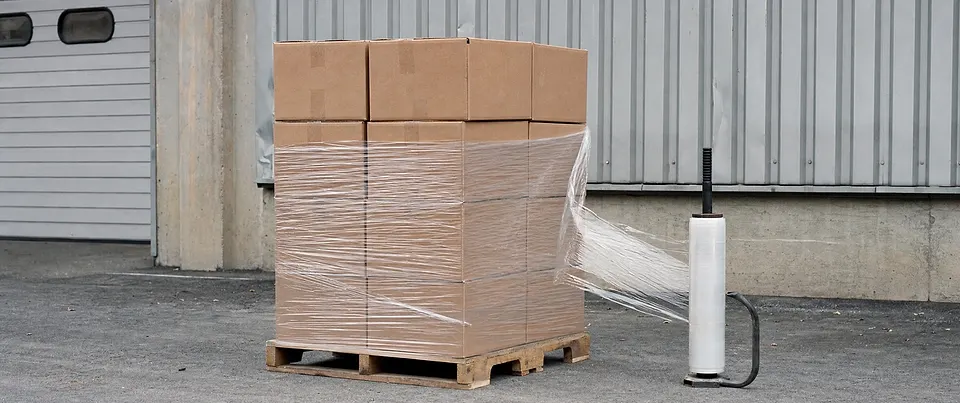
Lock the film to the pallet first with two or three turns at the base, climb the load with each pass overlapping the last, put extra turns round the top tier, then tuck the tail. The base wraps are the ones people skip, and they are the ones that keep a load on its pallet.
By hand, step by step
- Check the load. Square the stack on the pallet, nothing overhanging the deck, heavy cases at the bottom.
- Tie the film on. Tuck the film end into a gap between cartons near a bottom corner, or twist it round a corner post.
- Wrap the base. Go round the bottom two or three times, bringing the film down over the top boards of the pallet.
- Climb with overlap. Walk round climbing slowly, each pass overlapping the one below.
- Wrap the top. Two or three turns round the top tier, rolling the film over the top edge.
- Come back down and tuck. Spiral down part way, then cut and press the tail flat against the film so it clings.
Keep tension on the roll as you walk: hold it so the film stretches between your hand and the load. By hand you will get roughly 25 to 100 percent stretch,2 so steady tension matters more than speed. Walk forwards, not backwards, round the load.
On a turntable wrapper
The machine does the same pattern, set by the operator: the number of base turns, top turns, the carriage speed up and down the mast (which sets the overlap), and the pre-stretch. Attach the film tail to the pallet or a corner, start the cycle, and cut and wipe the tail down at the end. Machine film stretches 150 to 350 percent on a powered carriage,2 so the setting matters as much as the film.
How many times round
There is no single number. Light, square loads need fewer turns; heavy or tall ones need more, or a heavier gauge from the gauge chart.3 The way to know is to measure containment force, the squeeze of all the layers, at the top, middle and bottom of a wrapped load, at least once a shift.1 If one zone is low, add turns there; if all three are well above what the load needs, take turns away.
Mistakes that undo a wrap
- No base turns. The stack is wrapped to itself but not to the pallet, and slides off it under braking.
- A gap at the top. The top tier works loose in the trailer and falls into the aisle at the other end.
- Film roped into a cord. A rope of film cuts cartons and holds less than a flat web.
- A loose tail. It unwinds on the forklift and catches on the next pallet.
Awkward loads
Short loads, a single tier of heavy cases, need the base turns more than any climb; two passes round the top edge is often enough. Tall, light loads, such as empty containers or bottles, sway: put the heavy tiers low, keep tension moderate so the film doesn't crush them, and add a turn half-way up. Overhanging cartons catch film and tear it; square them up or use corner boards. Two pallets wrapped as one for a short move in the plant can be done, but don't ship them that way.
Safety at the wrapper
Walking backwards round a pallet with a roll is how people trip over pallet jacks and forks; walk forwards and keep the floor clear. Wear gloves if the film edge or the cartons cut. On a turntable, keep hands and feet clear while it turns, use the stop control rather than reaching in, and lock it out before clearing a jammed carriage. Cut the tail with a proper film cutter, not a loose blade.
It is worth getting right. Lantech, which makes wrappers, says about half of in-transit product damage traces back to wrapping that didn't hold.4 Then see containment force for how to check a wrap, and hand film for the rolls.
Training new wrappers
Show the pattern on a real load, then watch the new person wrap three or four pallets and check them. Common early habits are too little tension, skipping base turns when busy, and leaving long tails. A short card at the dispenser rack listing base turns, top turns and the tuck helps every new starter, and a containment reading on their first loads shows whether the habit has stuck.
Odd pallet sizes
Half pallets, display pallets and export sizes need the same pattern with fewer or more turns. Keep the film on the deck boards whatever the footprint. On a narrow half pallet, go slower at the base: a light, tall load tips more easily while the first turns pull at it.
Corner boards
L-shaped boards along each vertical edge spread film pressure and stiffen tall stacks. Hold them in place with the first base turns, then climb.
Questions readers ask
- Should the film go clockwise or anticlockwise?
- It doesn't matter for holding power, as long as each operator is consistent and the cling side faces inward. Most people walk the direction that suits their dominant hand.
- How much overlap between passes?
- Around half the film width is a common starting point. More overlap means more layers and more containment, and more film used.
- Should the film touch the floor?
- No. Carry it down onto the pallet's top boards or the upper part of the blocks, not to the floor, or forks will tear it and it will drag.
- Should we wrap the pallet itself into the load?
- Yes, that is what the base turns do: catching the top deck boards ties load and pallet together so they move as one. Avoid wrapping over fork entries, which blocks the tines.
Sources
- Lantech, "Use the force: containment force is the key to safe pallet loads" (reviewed 2026-11-13)
- Colony Packaging, "4 differences between stretch film and shrink film" (reviewed 2026-11-13)
- AAA Polymer, "A guide to buying stretch wrap film" (reviewed 2026-11-13)
- Lantech (a stretch wrapper maker), lantech.com (reviewed 2026-11-13)
Facts on this page last reviewed 2026-11-13.