Stretch wrap for cold storage
Cold stores wrap pallets in conditions film doesn't like: low temperatures that stiffen it, and doors to warm docks that make loads sweat. Refrigerated warehousing employed 73,136 people in 2025 across 1,811 private establishments.1 USDA counts refrigerated capacity state by state; California alone had 400 million cubic feet on October 1, 2025.2
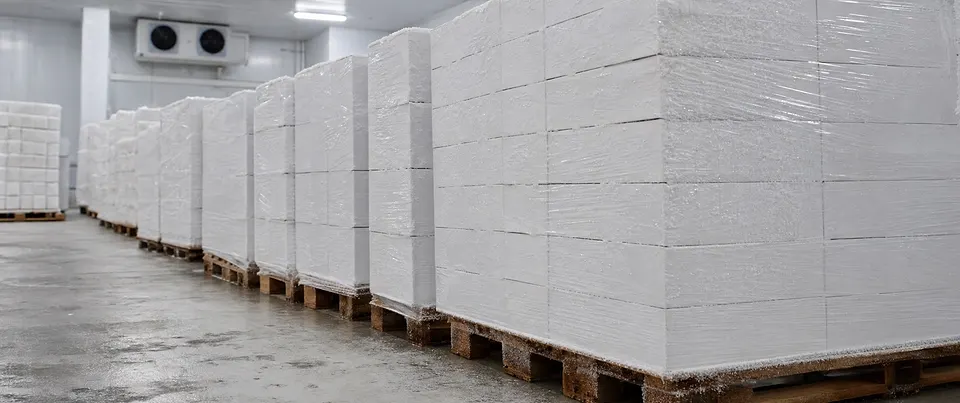
The loads, and the film for each
Start from what is on the pallet.
Frozen cartons going to a warm dock
Vented filmLets condensation escape instead of soaking the cartons.
Fresh produce cooling down
Vented film or nettingField heat must keep leaving the load after it is wrapped.
Chilled cases that stay cold end to end
Cold-rated machine filmSolid film is fine when the load never warms; check its temperature rating.
Mixed outbound pallets
Blown hand filmIrregular faces built in the cold; blown film clings and resists tears.
Where the industry is
States with the most jobs in it, BLS QCEW 2025.
- California9,969 jobs
- Texas6,638 jobs
- New Jersey5,388 jobs
- Georgia4,453 jobs
- Pennsylvania4,102 jobs
US total in refrigerated warehousing: 73,136 private jobs across 1,811 establishments, 2025 annual average.1
Condensation and the vents
The cold-chain rule.
Vented film is for produce, flowers, frozen and damp goods. Never wrap solid film over it; it adds little rigidity, so tall loads may want corner boards; and over-tension closes the vents.3 For loads that stay cold door to door, solid film is fine, but read the temperature rating: one common 20 inch machine roll is rated from 0 to 120 °F.4 If your wrapper sits inside a freezer, say so in the request.
From blast freezer to trailer
Where the film is tested.
Pallets in public refrigerated warehouses are often wrapped twice: once by the producer before shipping in, and again after picking or consolidation on the way out. The second wrap usually happens in a chilled dock, so the film is cold before it touches the load. Keep spare rolls in a warmer room nearby, change them often, and watch for the tail lifting, which is the first sign that cling has dropped with the temperature. Ice on the cartons also stops film gripping; brush it off first.
Labels and racking in the cold
Small things that cost picks.
Paper labels on frosty cartons peel, and film over them fogs. Apply labels before wrapping where possible, or use freezer-grade labels on the outside. In the racks, a loose film tail catches on a beam as the pallet goes in or comes out and can drag the wrap open; tuck every tail before the forklift lifts the load.
Questions from these docks
- Does film stiffen in a freezer?
- Yes. Film that runs well at room temperature can tear or lose cling in the cold. Store rolls warm and ask for film rated for the temperature it will be wrapped at.
- Should every cold pallet get vented film?
- No: only loads that need air or will sweat. Loads that stay cold from end to end are fine in solid film.
- What happens when frozen loads thaw in transit?
- They sweat heavily and cartons soften. Vented film lets moisture out; solid film traps it against the cardboard.
Sources
- BLS QCEW 2025, refrigerated warehousing (NAICS 49312) (reviewed 2026-11-12)
- USDA NASS, Capacity of Refrigerated Warehouses, October 1, 2025 (reviewed 2026-11-12)
- Racklify, "How to choose and apply vented stretch film for cold, frozen and damp products" (reviewed 2026-11-13)
- Uline, machine-length cast stretch film, 80 gauge, 20 in x 5,000 ft (product listing) (reviewed 2026-11-13)
Facts on this page last reviewed 2026-11-13.
Ask for a stretch film quote
Say how cold the load is when wrapped and where it goes next, then the film you use and rolls a month.
- Step 1 asks what you need, how much a month, the delivery ZIP and how to reach you
- Step 2 asks the film, the width and the gauge; skip what you don't know