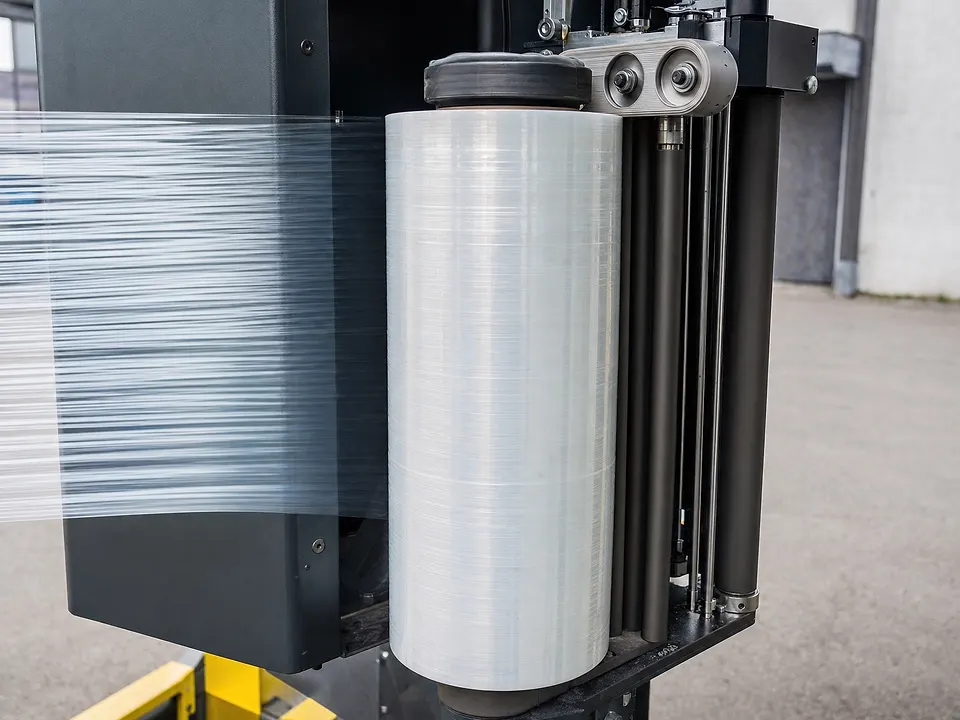
30 inch machine stretch film
| Width | 30 in |
|---|---|
| Core | 3 in |
| Fits | Carriages built for a 30 in roll |
| Made | Cast or blown |
| Bought | By the pallet of rolls |
Half again as wide as the standard 20 inch roll, so each turn of the turntable covers more of the stack. On tall loads that means fewer passes and a shorter cycle. It only runs on a carriage made to take it.
When wider helps
Tall loads and busy wrappers.
A wider web climbs a tall stack in fewer turns, and fewer turns is less time on the turntable per pallet. That matters on a wrapper that runs all shift. On short pallets the extra width just overhangs the top, so a 20 inch roll does the job with less film.
Check before you switch
The carriage and the roll weight.
A 20 inch by 5,000 foot roll already weighs about 32 pounds;1 a 30 inch roll of similar length is heavier still to load onto the carriage. The rollers, the film path and the mast have to be made for that width. After any change of film, check containment force at the top, middle and bottom of a load.2
Loads that justify 30 inches
Height, volume and stability.
Tall pallets of light goods, such as empty containers, insulation, bedding, packaging materials and stacked plastic crates, reach well above the height a 20 inch roll covers comfortably. A wider web wraps them in fewer passes, and the broader band of film across each tier helps keep a tall, light stack from swaying. Sites that run long production shifts on one wrapper value the shorter cycle most. Low, dense pallets gain nothing from the extra width and only use more film at the top.
Ask your wrapper maker whether the carriage can be converted between widths; some can, with a change of rollers, and some can't.
Automatic lines
Where wide film is most common.
Fully automatic wrappers at the end of a production line, fed by conveyor, often run wider film because they wrap a pallet every minute or two without an operator. Every pass saved adds up across a shift. Those machines also tend to have cut-and-clamp systems that start and finish the wrap by themselves, and they are sensitive to roll quality: a telescoped roll or a crushed core can stop the line. Ask for rolls packed upright in cartons or on tier sheets, and inspect a sample from each delivery before loading it.
Semi-automatic turntables, where an operator attaches the film and starts the cycle, more often stay with 20 inch rolls.
Wide hand rolls
Not the same thing.
Hand rolls wider than 20 inches are rare, since they are awkward to carry and stretch. Thirty inches is a machine width.
Questions buyers ask
- Will a 30 inch roll fit my wrapper?
- Only if the carriage was made for it. The rollers, film path and roll holder are set for one width; ask the wrapper maker or check the carriage plate before ordering.
- Does wider film use more film per pallet?
- Not necessarily. Fewer turns climb the load, so the total can be similar or less, as long as the overlap is set right. On short loads, though, the extra width just overhangs the top.
- Is it harder to load onto the carriage?
- A wider roll of similar length weighs more, so loading it is heavier work. Plan for that where operators change rolls by hand.
- Is there a 30 inch roll at a lighter gauge?
- Yes. Wide rolls are made across the usual gauges, so you can pair the width with a lighter film if your loads hold on it.
- Does wider film waste more at the top?
- On short loads, yes; set top turns carefully, and consider keeping a 20 inch carriage for low pallets.
Related rolls
Sources
- Uline, machine-length cast stretch film, 80 gauge, 20 in x 5,000 ft (product listing) (reviewed 2026-11-13)
- Lantech, "Use the force: containment force is the key to safe pallet loads" (reviewed 2026-11-13)
Facts on this page last reviewed 2026-11-13.
Ask for a stretch film quote
Give the wrapper model and the height of your tallest loads, with rolls a month.
- Step 1 asks what you need, how much a month, the delivery ZIP and how to reach you
- Step 2 asks the film, the width and the gauge; skip what you don't know