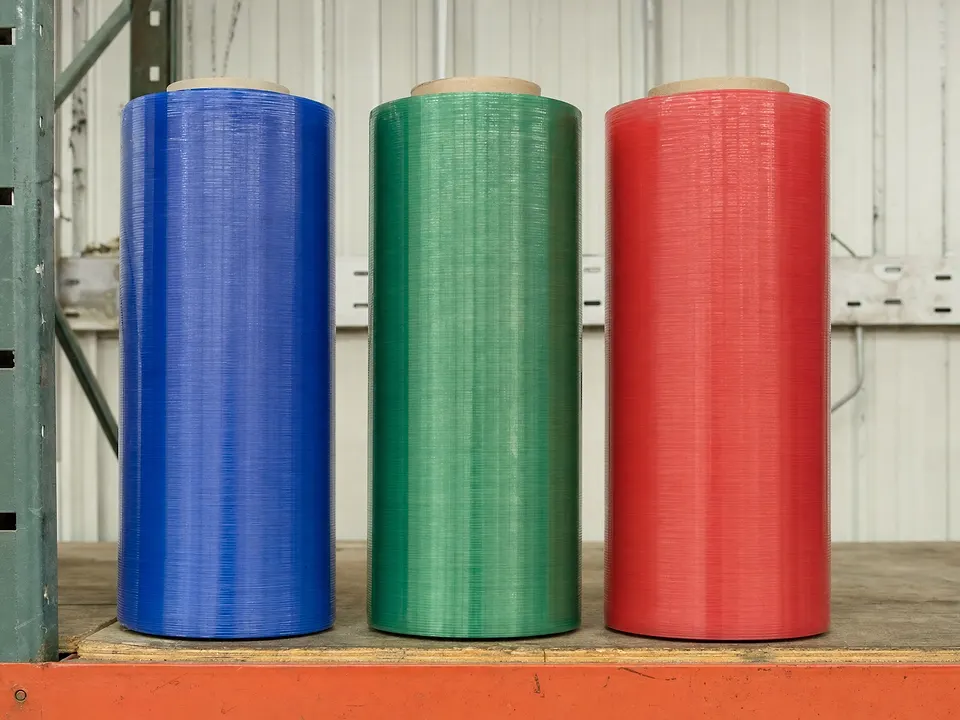
Colour-tinted stretch wrap
| Colours | Blue, red, green, yellow and others |
|---|---|
| See-through | Yes: tinted, not opaque |
| Hand | By the case |
| Machine | By the pallet |
| Used for | Colour coding and dating inventory |
A tint you can still see through. A buying guide lists tinted film for colour coding and for dating inventory:1 a colour per shift, per week, per customer or per route, readable from across the warehouse without walking up to a label.
Ways docks use colour
A code is only as good as everyone knowing it.
By date: one colour a week, so stock rotation is visible at a glance. By shift: a problem pallet can be traced to the crew that wrapped it. By customer or route: loaders pick the right lane without reading each label. By status: quarantine, rework or hold in one colour nobody else uses. Keep the code short, post it at the wrapper, and stick to it.
What tint doesn't change
Strength is still the gauge.
The colour is in the film, not on it, so it doesn't rub off. It doesn't change how the film holds: pick the gauge and cast or blown exactly as for clear film. Tinted film stays see-through, so labels can still be read and scanned through a layer or two. If the load must be hidden, use opaque film instead.
Setting up a colour code
A few habits make it stick.
Decide what the colour means before ordering: date, shift, customer, route or status. Choose colours that stay distinct under your warehouse lighting, and avoid two shades that look alike when wrapped over brown cartons. Keep a roll of each colour at every wrapper, not in a central store, or people will grab whatever is nearest. Write the code on a sign by the wrapper and in the receiving instructions, so the dock at the other end reads it the same way. Order quantities by colour, since some will run faster than others.
Colour beyond coding
Other reasons docks tint.
Tinted film also deters casual mixing between companies sharing a warehouse: each tenant wraps in its own colour, so pallets don't wander into the wrong lane. Some retailers ask suppliers for a particular colour on promotional or seasonal stock, so it is pulled forward on arrival. And a tint on cores or film helps a recycling programme sort one site's film from another's. Whatever the reason, write it down; codes nobody remembers are worse than none.
Some recyclers want tinted film kept apart from clear; check before mixing bales.
Questions buyers ask
- Which colours are available?
- Blue, red, green and yellow are common; ask for the colour you need. Pick colours your crew can tell apart under your warehouse lighting.
- Does tinted film hold as well as clear?
- Yes, at the same gauge and type. The tint changes the look, not the strength.
- Can I code by colour and still scan labels?
- Yes, through a layer or two: tinted film stays see-through. Through many layers, put the label on top.
- How many colours should a code use?
- As few as will do the job. A weekly date code needs four or five colours; a shift code, two or three. More colours than people can remember stop working as a code.
- Do tints look the same under every light?
- No. Warehouse lighting shifts colours, so test sample rolls under your own lights before fixing a code.
- Can tints be mixed on one pallet?
- Yes, a band of colour over clear film marks a load just as well.
Related rolls
Sources
- Uline, stretch wrap guides (reviewed 2026-11-13)
Facts on this page last reviewed 2026-11-13.
Ask for a stretch film quote
List the colours you need and roughly how many rolls of each a month.
- Step 1 asks what you need, how much a month, the delivery ZIP and how to reach you
- Step 2 asks the film, the width and the gauge; skip what you don't know