Cast vs blown stretch film
Use cast film for square, uniform loads and anywhere you need to see through the wrap; use blown film for irregular loads and sharp corners.1 Cast is clearer and quieter; blown is tougher and clings harder.2
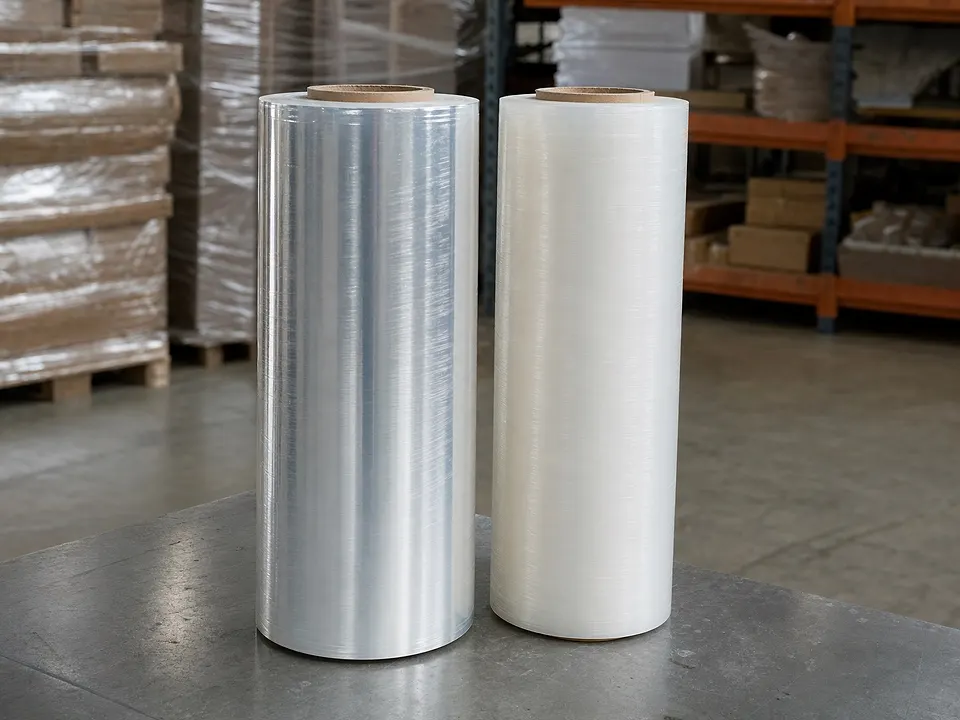
How each is made
Cast film is extruded through a flat die as a thin sheet and cooled at once on chilled rollers. The quick chill gives it clarity, an even thickness and a quiet unwind.2
Blown film is extruded upward as a tube, inflated into a tall bubble and cooled slowly by air. The slower cooling and the stretch in two directions as the bubble grows give it toughness, puncture resistance and stronger cling, at the cost of some haze and a louder unwind.2
Cast is the larger share of what is made: about 70 to 80 percent, with blown about 20 to 30, by one wrapper maker's estimate.2
Side by side
| Cast | Blown | |
|---|---|---|
| Clarity | Clear; labels read through it | Hazier |
| Unwind | Quiet | Loud |
| Thickness | Even across the web | Less even |
| Puncture and tear | Good on square loads | Better on corners and edges |
| Cling | Good | Stronger |
| Suits | Uniform loads | Irregular loads |
Choosing by load
A buying guide puts it in one line: cast for uniform loads, blown for irregular ones.1 Uniform means cases of one size stacked square: drinks, canned goods, boxed consumer products. Irregular means mixed cartons, drums, bagged goods that slump, metal with edges, totes of parts.
On a wrapper with a powered carriage, cast's even thickness lets it stretch predictably and hard; one listed 80 gauge cast machine roll stretches up to 250 percent.4 By hand, where stretch is low, blown's cling and toughness often matter more. The common blown hand roll is 18 inches by 1,500 feet at 80 gauge, four to a case.3
Films that sit between the two
The line has blurred. Both kinds are now co-extruded in several layers, and makers build cast films with a tougher core layer, or blown films that run cleaner and quieter than the old ones. Read the data sheet rather than the name: what matters on your loads is puncture resistance at the corners, cling on the tail, and how far the film stretches before it starts to neck. Two rolls labelled "cast" can differ more than a cast and a blown roll do.
Running a fair trial
To settle it for your own pallets, run each film for a full shift on the same kind of load, with the same pattern and wrapper settings. Count breaks, count loads per roll, and measure containment force at the top, middle and bottom of a sample. Ask the receiving dock which pallets arrived worse. A day each is usually enough to see which film suits the load, and the results are worth more than any comparison table, including the one above.
When it doesn't matter much
For light, square loads going a short distance, either film holds. Pick on the things you notice every day: noise in the wrapping area, whether the receiving dock needs to read labels through the wrap, and how the tail behaves when you tuck it. Then see cast stretch film or blown stretch film for the rolls.
Cost per pallet, not per roll
Blown film often costs more per roll. If it lets you drop a gauge, cut breaks, or skip corner boards, it can still cost less per pallet shipped. Work out both before choosing on price.
Myths worth dropping
"Blown is always stronger." Not on every measure: a good cast film can match or beat a blown one on tensile strength, while blown usually wins on puncture. "Cast is cheap film." Cast is the volume product because it suits the volume load, square cartons, not because it is inferior. "Noise means quality." The crackle of blown film comes from how it is made, not from how well it holds. Judge each on breaks, yield and containment, measured on your pallets.
Static and dust
Both films build static unwinding, which attracts dust in dirty warehouses; blown's rougher surface may show it more. Keep rolls boxed until use and dock areas swept.
Questions readers ask
- Can we run cast on one wrapper and blown on another?
- Yes, and many sites do: cast on the line that wraps square cases, blown where mixed or sharp loads are wrapped. Label the wrappers so rolls aren't swapped by mistake.
- Is blown film better in the cold?
- Its toughness helps on cold docks, where film is stiffer and more likely to tear on a corner. Either kind should be rated for the temperature it is wrapped at.
- Why is cast cheaper in some quotes?
- Cast is made in larger volume, about 70 to 80 percent of stretch film by one estimate, and cast lines run fast. Compare price per pallet wrapped, not per roll.
- Which suits a rotary-arm wrapper?
- Either. Rotary arms are often bought for unstable or very heavy loads, which tend to favour blown film, though tall towers of identical boxes still run happily on cast.
Sources
- Uline, stretch wrap guides (reviewed 2026-11-13)
- Lantech, "Blown vs. cast: how is stretch film made?" (reviewed 2026-11-13)
- Interplas, 18 in x 1,500 ft x 80 ga blown hand stretch wrap (product listing) (reviewed 2026-11-13)
- Uline, machine-length cast stretch film, 80 gauge, 20 in x 5,000 ft (product listing) (reviewed 2026-11-13)
Facts on this page last reviewed 2026-11-13.