Stretch wrap for chemical plants
Chemical plants ship some of the heaviest and least forgiving pallets there are: drums that roll, pails that slide, sacks that slump, and liquid weight that surges. Chemical manufacturing employed 892,426 people across 25,801 US establishments in 2025.1 Texas leads, and around Houston the industry is 2.2 times its national share.2
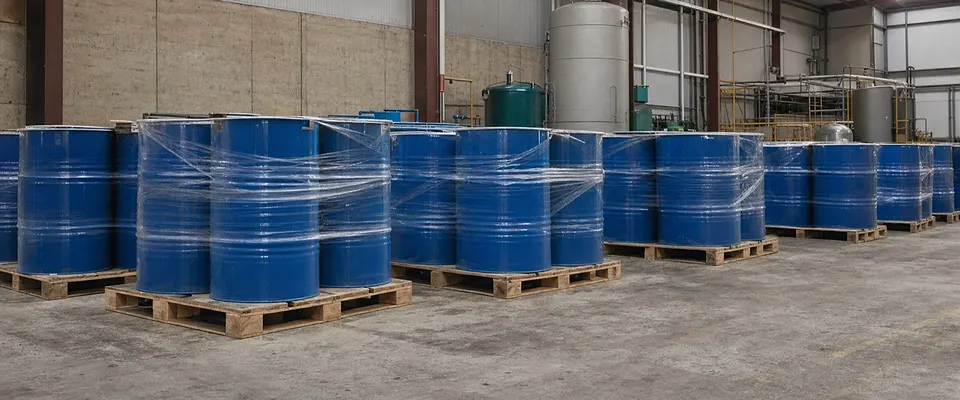
The loads, and the film for each
Start from what is on the pallet.
Drums, four to a pallet
Blown film, 100 gaHeavy, round and liable to shift; 100 to 115 ga is the chart's step for 3,000 lb and up.
Sacks of resin and powder
Blown film, 80 to 90 gaBags slump into a rounded face; blown film clings and holds it.
Where the industry is
States with the most jobs in it, BLS QCEW 2025.
- Texas90,310 jobs
- California75,499 jobs
- Ohio49,328 jobs
- Illinois48,745 jobs
- New Jersey47,966 jobs
US total in chemical manufacturing: 892,426 private jobs across 25,801 establishments, 2025 annual average.1
Heavy, round and liquid
Why chemical loads go heavier.
The buying guide's heaviest step, 100 to 115 gauge, is for loads of 3,000 pounds and up.3 A pallet of four full drums gets there easily. Round drums leave voids the film has to bridge, so blown film's toughness and cling matter more than clarity. Houston's ship channel handled 54,491,066 short tons across Port Houston's public terminals in 2025, with petrochemical and plastics cargo among it;4 see Houston.
Bulk bags and totes
Large single units.
Intermediate bulk containers, the caged plastic totes, and flexible bulk bags of powder or pellets are single large units rather than stacks. Film round them keeps dust out, holds labels in place and stops a bag sagging over the pallet edge; it does not hold the load together in the way it does for cases. Use a heavier blown film, keep it away from discharge spouts and valves, and make sure hazard labels stay visible or go on the outside after wrapping.
Film keeps containers together, not contents in. Keep spill kits where drums are wrapped.
Stacked pails interlock poorly; wrap firmly at every layer, and add a top sheet under the film if the lids must arrive clean.
Questions from these docks
- Should drums be wrapped at all?
- Wrapping four drums together stops them shifting on the pallet. Use blown film, firm base turns, and strapping too if your procedures call for it.
- Can film handle a chemical spill?
- No. Stretch film holds a load together; it is not a containment barrier for leaks.
- Can film cover hazard labels?
- Clear film over a label should leave it readable; if it doesn't, put the label on the outside. Hazard markings must stay visible in transport.
Sources
- BLS QCEW 2025, chemical manufacturing (NAICS 325) (reviewed 2026-11-12)
- BLS QCEW 2025, all private industries (reviewed 2026-11-12)
- AAA Polymer, "A guide to buying stretch wrap film" (reviewed 2026-11-13)
- Port Houston, "Port Houston celebrates best year yet" (January 2026) (reviewed 2026-11-12)
Facts on this page last reviewed 2026-11-13.
Ask for a stretch film quote
Say what the load is, drums, pails, totes or sacks, and its weight; then the film and the monthly count.
- Step 1 asks what you need, how much a month, the delivery ZIP and how to reach you
- Step 2 asks the film, the width and the gauge; skip what you don't know