Stretch wrap for beverage plants
A pallet of drinks is one of the heaviest things a warehouse moves for its footprint, and the weight is liquid. Beverage manufacturing employed 316,938 people across 16,316 US establishments in 2025.1 Those plants ship cans, glass, plastic bottles and kegs, and each wants holding differently.
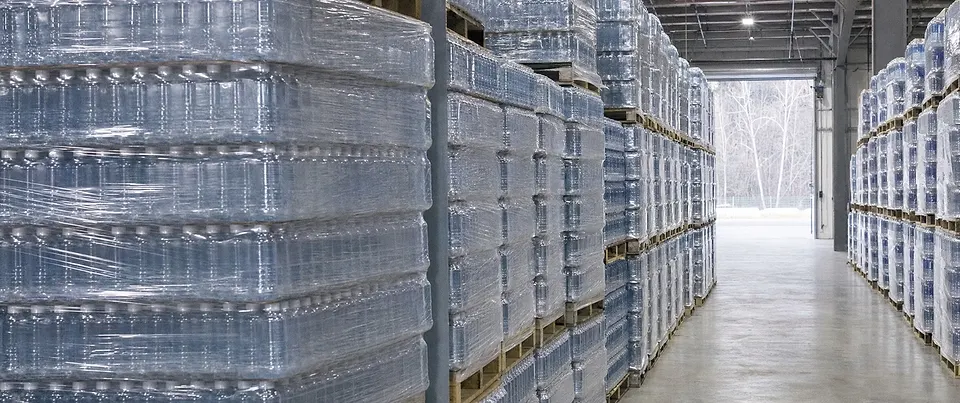
The loads, and the film for each
Start from what is on the pallet.
Full cases of cans or bottles
Machine film, 90 gaHeavy, dense loads; 90 gauge suits loads up to about 2,600 lb on the buying-guide chart.
Empty glass on tier sheets
Cast film, 80 gaLight but fragile; the film has to keep the tiers from sliding without crushing.
Mixed route-delivery pallets
Hand film by the caseBuilt to order at the warehouse and wrapped by hand.
Where the industry is
States with the most jobs in it, BLS QCEW 2025.
- California63,604 jobs
- Texas24,154 jobs
- New York13,802 jobs
- Pennsylvania13,207 jobs
- Florida12,661 jobs
US total in beverage manufacturing: 316,938 private jobs across 16,316 establishments, 2025 annual average.1
Holding liquid weight
Base turns and the top tier.
California has more beverage jobs than the next three states put together. Wherever the plant is, the failure is the same: the top tiers keep moving when the truck stops. A buying guide puts 90 gauge at loads up to 2,600 pounds and 100 to 115 gauge above 3,000;2 many drink pallets sit between. Extra turns at the top and the base, and a measured check of containment force at top, middle and bottom,3 matter as much as the gauge. Glass has its own risk: too much wrap force can crush a tier of empties.
Drinks often reach the wrapper already shrink-bundled into multipacks on the filling line, so the stretch film is holding slippery bundles together, and cling and top turns matter more than usual. Empties travel the other way: can makers ship empty cans in tall layers on tier sheets, light loads where the film's job is to stop the tiers sliding.
Kegs and returnable shells
Round loads and reusable crates.
Kegs stand on pallets in rows and roll if the film loosens; firm base wraps and a band round the top rims hold them. Returnable crates and shells come back for reuse, so film that leaves residue or strands in the handles slows the line that cleans them. Blown film with good cling and a clean cut-off suits both.
Questions from these docks
- Should we wrap glass empties tighter?
- No. Glass on tier sheets needs enough hold to stop the tiers sliding, not crushing force. Lower the wrap force and add turns instead.
- Cans or bottles, does it change the film?
- Cans are heavier per pallet; plastic bottles flex and settle. Both want firm top wraps; plastic bottles benefit from blown film's cling.
- How tight should cased wine be wrapped?
- Firm enough to stop cases sliding, gentle enough not to crush the cartons or the glass. Moderate tension and more turns works better than a hard pull.
Sources
- BLS QCEW 2025, beverage manufacturing (NAICS 3121) (reviewed 2026-11-12)
- AAA Polymer, "A guide to buying stretch wrap film" (reviewed 2026-11-13)
- Lantech, "Use the force: containment force is the key to safe pallet loads" (reviewed 2026-11-13)
Facts on this page last reviewed 2026-11-13.
Ask for a stretch film quote
Say what the pallets carry, cans, glass, plastic or kegs, and the weight; then the film you use and rolls a month.
- Step 1 asks what you need, how much a month, the delivery ZIP and how to reach you
- Step 2 asks the film, the width and the gauge; skip what you don't know