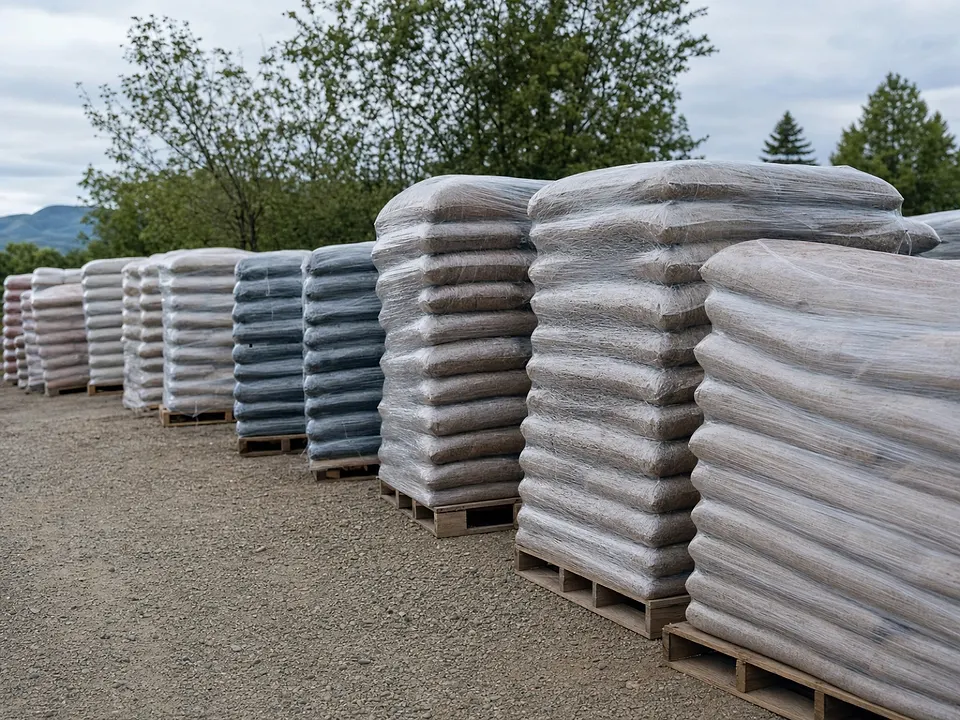
UV-inhibited stretch wrap
| What it is | Stretch film with an additive that slows sunlight damage |
|---|---|
| For | Pallets stored or staged outdoors |
| Hand | By the case |
| Machine | By the pallet |
| Ask for | The rated outdoor life on the data sheet |
Sunlight breaks down ordinary polyethylene film. Left in a yard for weeks, a clear wrap goes brittle, splits and lets the load go. UV-inhibited film carries an additive that slows that down, so a pallet staged outside holds together until it is moved.
When it is worth it
Weeks outside, not hours.
A pallet that crosses a sunny yard to a trailer doesn't need it. Pallets that sit outside for weeks do: building products in a yard, plants and garden goods, empty containers waiting for pickup, anything stored outdoors through a summer. The longer the stay and the stronger the sun, the more it matters. Ask for the rated outdoor life on the maker's data sheet and compare it with how long your pallets actually wait.
What it doesn't do
It slows ageing; it isn't a cover.
UV film still lets rain in at the top unless the top is covered, and it doesn't stop the load inside from fading. For a load that must stay dry outdoors, a top sheet under the wrap, or a pallet cover, does that part of the job. Choose the gauge from the load as usual.
Which loads end up outdoors
More than you might expect.
Garden centres stage pallets of compost, mulch and pots in the sun for the whole season. Building suppliers keep insulation, pipe, block and roofing products in open yards. Bottling plants and container makers stack empties outside to wait for space indoors. Farms and nurseries store feed and supplies under the sky. In each case, the film may need to last months, through heat, wind and sunlight. A standard film that is fine for a week can split along the top edge within a summer, letting the top tier fall or blow away. Choosing white UV film adds reflection to the protection.
Reading the outdoor rating
Months, sun and latitude.
Makers usually rate UV film by how many months of outdoor exposure it is designed to survive, often for a stated climate. Sunlight is stronger in the south-west than in the north-east, and stronger in summer than in winter, so a film rated for a few months may last longer in Ohio than in Arizona. Treat the rating as a guide, inspect loads that have been outside the longest, and rewrap any whose film has turned chalky or brittle.
UV film indoors
No harm, no gain.
Using UV film on loads that never leave the warehouse does no harm, but you are paying for protection you don't need. Keep it for the yard.
Colour and UV together
Combined films.
UV inhibitors can be added to white, black or tinted film, so an outdoor load can be hidden, coded and protected by one roll. Ask which combinations the maker offers.
Questions buyers ask
- How long will UV film last outside?
- The maker rates it on its data sheet, usually in months of exposure. Ask for the sheet with the quote, and compare it with how long your pallets actually wait outside.
- Is white film the same as UV film?
- No. White opaque film reflects sunlight and keeps the load cooler; UV-inhibited film carries an additive that slows the film's own breakdown. Some films are both.
- Does UV film cost more to run?
- We don't publish prices. Compare the cost of a rewrapped or spoiled pallet with the cost of the film, and decide by how long loads sit outside.
- What fails first on a pallet left outside?
- The film on the sunny side and the top edge, where it is stretched over a corner. That is where an ordinary wrap splits first.
- Does UV film change colour as it ages?
- Ordinary film often yellows and turns chalky in sunlight before it splits. UV film slows that; when it starts, rewrap.
Related rolls
Ask for a stretch film quote
Say how long pallets sit outside and in what climate, with the size and quantity.
- Step 1 asks what you need, how much a month, the delivery ZIP and how to reach you
- Step 2 asks the film, the width and the gauge; skip what you don't know