Stretch wrap for food and beverage
Food plants ship some of the heaviest, most regular pallets in any warehouse: cases of cans and bottles, sacks of flour and sugar, boxed dry goods, frozen cartons. Food manufacturing employed 1,775,008 people across the US in 2025,1 and nearly every case they made left on a wrapped pallet.
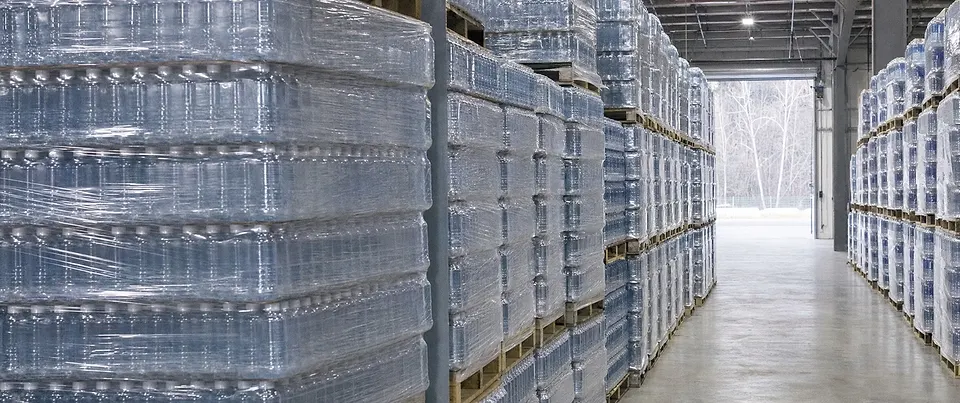
The loads, and the film for each
Start from what is on the pallet.
Cases of canned or bottled drinks
Machine film, 80 to 90 gaHeavy, dense and liquid: the load surges forward under braking. It needs high containment force at the base and top.
Bagged flour, sugar and ingredients
Blown film, 80 gaSacks slump and shift; blown film clings and holds an uneven face.
Boxed dry goods and snacks
Cast film, 63 to 80 gaLight, square cases. Clear cast film lets labels scan through it.
Frozen cartons
Cold-rated or vented filmFilm stiffens in the cold, and cartons sweat on the way to a warm dock.
Where the industry is
States with the most jobs in it, BLS QCEW 2025.
- California166,660 jobs
- Texas112,088 jobs
- Illinois98,300 jobs
- Pennsylvania82,538 jobs
- Wisconsin81,993 jobs
US total in food manufacturing: 1,775,008 private jobs across 42,763 establishments, 2025 annual average.1
Why drink pallets are different
Weight that moves.
A pallet of drinks is heavy for its size and the weight is liquid, so it moves as one mass when a truck brakes. That is where containment force earns its keep: check it at the top, middle and bottom of the load, and at least once a shift.2 These loads often sit at the top of the gauge chart's middle bands, 2,200 pounds and above,3 so a buyer used to boxed goods may need a step heavier, or more base turns.
Food plants also keep records. FDA's Food Traceability Rule requires businesses handling foods on its list to keep key data for critical tracking events; FDA says it won't enforce the rule before July 20, 2028.4 Clear film keeps lot labels readable through the wrap, which helps.
Bakery, snacks and sacks
The lighter end of food.
Not every food pallet is heavy. Bread trays, crisps and cereal are bulky and light, and too much wrap force crushes them; turn the force down and rely on turns. Sacked ingredients are the opposite problem, heavy and soft, so the base wraps do the work.
Questions from these docks
- Is stretch film food safe?
- Stretch film goes round cases on a pallet, not round the food itself. If film is to touch food directly, ask for the maker's food-contact statement with the quote.
- Why do our drink pallets lean on arrival?
- Usually too little containment force at the top, or film that went on without enough base turns. Measure at the top, middle and bottom and add turns where it is low.
Sources
- BLS QCEW 2025, food manufacturing (NAICS 311) (reviewed 2026-11-12)
- Lantech, "Use the force: containment force is the key to safe pallet loads" (reviewed 2026-11-13)
- AAA Polymer, "A guide to buying stretch wrap film" (reviewed 2026-11-13)
- FDA, FSMA Food Traceability Rule (reviewed 2026-11-12)
Facts on this page last reviewed 2026-11-13.
Ask for a stretch film quote
Start with the load: drinks, bags, boxes or frozen. Then the wrapper or hand wrapping, and rolls a month.
- Step 1 asks what you need, how much a month, the delivery ZIP and how to reach you
- Step 2 asks the film, the width and the gauge; skip what you don't know