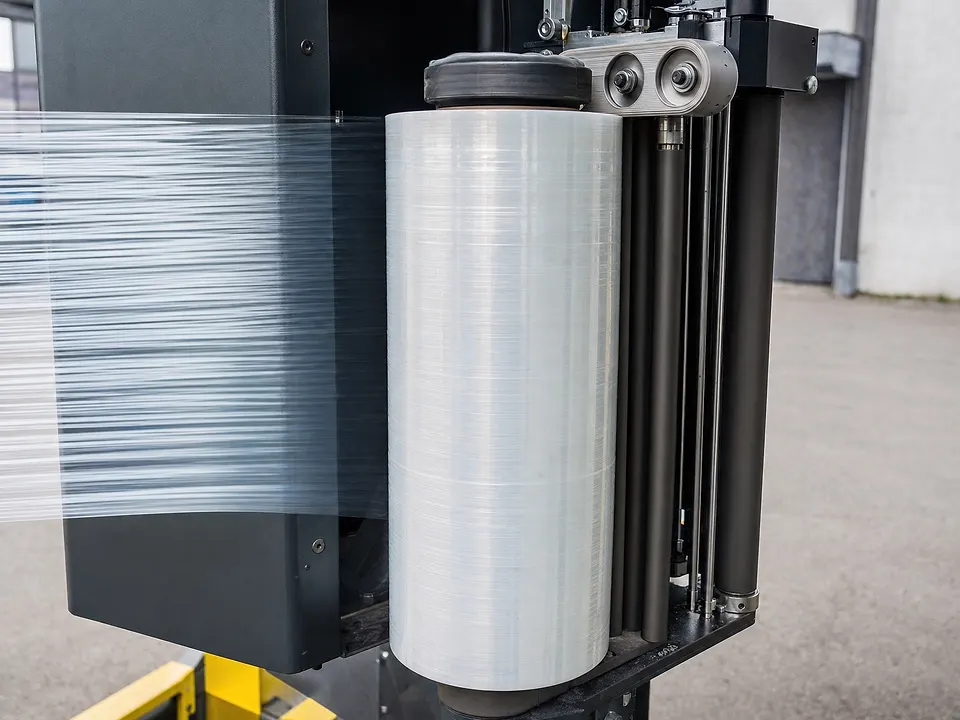
20 in x 5,000 ft machine film
| Width | 20 in |
|---|---|
| Length | 5,000 ft |
| Gauge | 80 ga in the listing below; others quoted to the load |
| Core | 3 in |
| Roll | About 9 in across, about 32 lb |
| Stretch | Up to 250% on a powered carriage |
| Rated | 0 to 120 °F |
In one published listing this roll is 80 gauge cast film with cling on both sides, rated for loads up to 2,500 pounds.1 That matches the buying guide's band for 70 to 80 gauge, which puts loads of about 2,200 to 2,400 pounds there.2
Same roll, different gauges
The size is fixed; the film inside it isn't.
Most turntable carriages take a 20 inch roll on a 3 inch core, so the size rarely changes. What changes is the gauge and the film. With a powered carriage running near 250 percent, many sites can try a step lighter than 80; one wrapper maker reports the industry average has fallen to about 65 gauge.3 With sharp-cornered or mixed loads, stay at 80 or go to a blown film at the same gauge.
Cold docks
Read the temperature rating.
The listing above is rated from 0 to 120 °F.1 If the roll lives on a wrapper in a freezer anteroom, say so in the request: film stiffens in the cold, and the quote should be for a film made for it. For pallets that have to breathe, see vented film.
Changing the roll
A minute that is easy to get wrong.
Threading a new roll through the pre-stretch rollers the wrong way round puts the cling face outwards, and loads then stick to each other in the trailer. Most carriages have a threading diagram on the door; follow it, and check which side of the film is marked as the cling side on the case. Lift the roll by the core onto the spindle rather than by the film, and keep the last few wraps of an old roll for short jobs instead of throwing a near-empty core away.
How many rolls a month
From cycles to cases.
Wrapper counters record cycles, which is the simplest way to plan film. Divide the cycles in a month by the pallets a roll wraps on your settings, and add a few rolls for changes and waste. The film-per-pallet guide shows how to work out pallets per roll if you haven't measured it.
Telescoping and crushed cores
Roll faults to reject.
A roll whose layers have slid sideways into a cone, called telescoping, feeds unevenly and breaks. A crushed core won't sit on the spindle. Send back either.
Questions buyers ask
- Is 5,000 feet the only length?
- It is the common length for a 20 inch machine roll; longer rolls exist for carriages that take them. Longer rolls mean fewer changes, but heavier lifts onto the carriage.
- Cast or blown on a turntable?
- Cast for square loads and quiet halls; blown for mixed loads with corners. Both come in this size.
- How do I know it suits my carriage?
- Check the core size, the maximum roll diameter and the roll weight your carriage takes. The listed roll is 3 inch core, about 9 inches across and about 32 pounds.
- How many spare rolls should we keep?
- Enough for at least a shift or two at each wrapper, so a late delivery or a damaged roll doesn't stop the line.
Related rolls
Sources
- Uline, machine-length cast stretch film, 80 gauge, 20 in x 5,000 ft (product listing) (reviewed 2026-11-13)
- AAA Polymer, "A guide to buying stretch wrap film" (reviewed 2026-11-13)
- Lantech, "Blown vs. cast: how is stretch film made?" (reviewed 2026-11-13)
Facts on this page last reviewed 2026-11-13.
Ask for a stretch film quote
Say the gauge you run now, cast or blown, and the rolls you go through a month.
- Step 1 asks what you need, how much a month, the delivery ZIP and how to reach you
- Step 2 asks the film, the width and the gauge; skip what you don't know