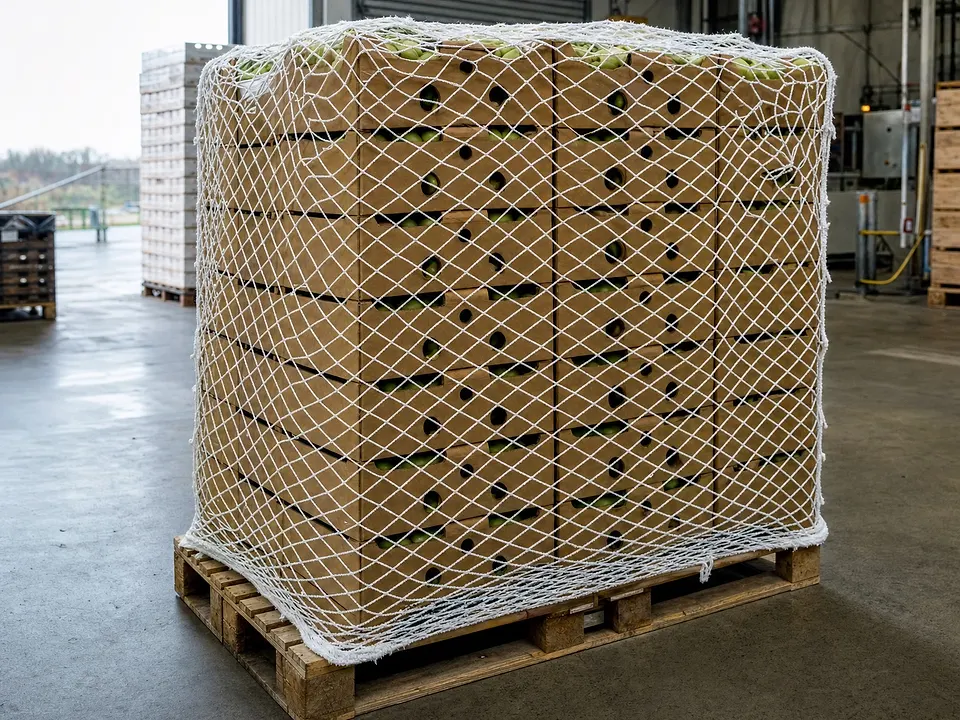
Stretch netting for pallets
| What it is | Knitted plastic mesh that stretches round a load |
|---|---|
| For | Produce, flowers and loads that need open airflow |
| Hand | By the case |
| Machine | For wrappers set up to run it |
| Compared with vented film | Far more open, less hold |
Where vented film is a sheet with holes in it, netting is mostly hole. Air moves through it almost freely, so it suits loads that must keep breathing hard: fresh produce cooling down, plants, firewood, anything that rots or sweats under film.
Netting or vented film
How much air against how much hold.
Using netting well
It holds by friction and count.
Because the mesh grips the load at many small points rather than squeezing it as a sheet, netting needs a stable stack and enough turns. Corner boards help on tall loads. Tie it off by tucking or knotting the tail rather than relying on cling, which netting doesn't have.
Beyond produce
Other loads that need to breathe.
Firewood and kindling in bundles, potted plants and nursery stock, sacks of potatoes and onions, and bottles or cans that are still warm from a filler or pasteuriser all suit netting. So do loads that must be inspected without unwrapping, since the mesh leaves labels and contents in view. Netting is lightweight and easy to cut away at receiving, and it can be reused for short internal moves. It is not for loads that need protecting from dust, insects or rain.
Mesh sizes and strength
What to ask for.
Netting comes in different mesh openings and strand weights. A fine mesh holds small cartons and gives more containment; a coarse mesh lets more air through and suits large crates and bins. Heavier strands resist snagging on forks and pallet corners. Tell us the product, the carton size and how long it travels, and the quote will suggest a mesh rather than leave you to guess.
Netting comes in colours too, which packers use to mark grade, grower or harvest day.
Questions buyers ask
- Can a turntable wrapper run netting?
- Some can, with the right carriage. Ask your wrapper maker before buying machine netting.
- Does netting stop small items falling out?
- No: the mesh is open. Use it on loads of cartons, crates or bins, not loose small product.
- Is netting reusable?
- Usually it is cut off and discarded like film. Some loads are re-wrapped with fresh netting at the next stop.
- Which is cheaper per pallet, netting or vented film?
- We don't publish prices. Choose by how much air the load needs first; netting where it must breathe hard, vented film where some air and more hold will do.
- How is netting stored?
- Dry and out of sunlight, like film. Ultraviolet weakens the strands over time, so rotate stock and keep part-used rolls in their cartons.
Related rolls
Sources
Facts on this page last reviewed 2026-11-13.
Ask for a stretch film quote
Say what the product is and whether you wrap by hand or machine.
- Step 1 asks what you need, how much a month, the delivery ZIP and how to reach you
- Step 2 asks the film, the width and the gauge; skip what you don't know