What stretch film is made of
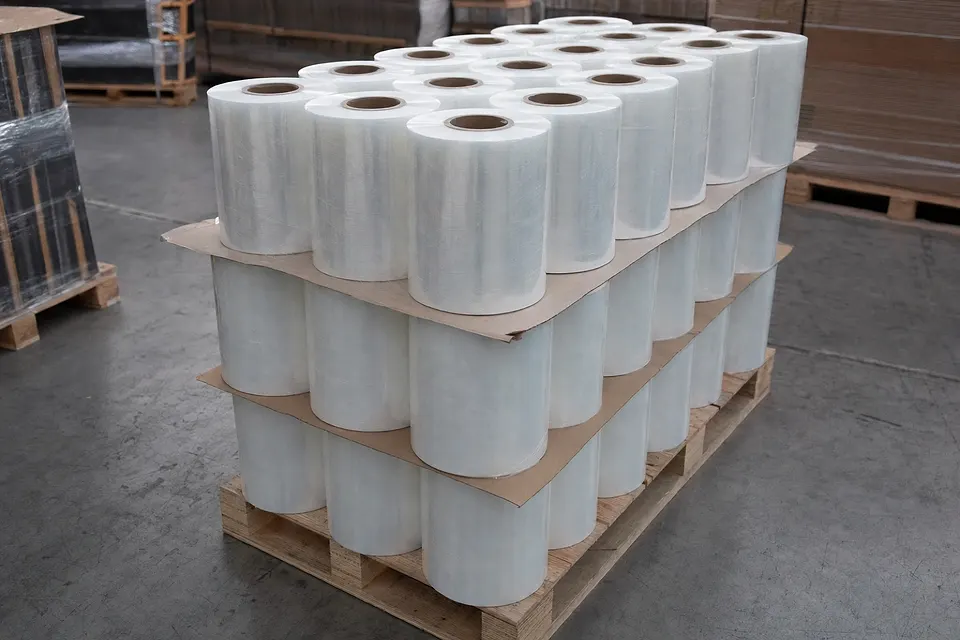
Stretch film is made mostly of linear low-density polyethylene, LLDPE, extruded in several thin layers either onto chilled rollers (cast) or as an air-cooled bubble (blown). The resin gives it stretch and toughness; the layers let a maker put cling on the outside and strength in the middle.
LLDPE
Linear low-density polyethylene is polyethylene made with short side branches on its long chains. Those branches let the chains slide past each other without breaking, which is what lets the film stretch far and spring back, and resist a puncture while stretched. A common machine roll is listed simply as 80 gauge cast LLDPE.1
Layers
Most stretch film is co-extruded: several layers, each from its own extruder, joined as the film is formed. A maker can put a cling layer on one or both faces, a tougher layer in the core, and a slip layer outside so rolls don't stick to each other. That is why a film is sold as one-sided or two-sided cling, and why two films of the same gauge can perform very differently.
Cast or blown
The same resin can be made two ways. Cast film is extruded flat and chilled fast on rollers: clear, quiet, even. Blown film is blown as a tall bubble and cooled by air: tougher, clingier, hazier and louder.2 The cast vs blown guide compares them load by load.
What the recipe changes on the dock
- How far it stretches. Hand films stretch about 25 to 100 percent, machine films 150 to 350.3
- Cling. Whether the tail stays put and the layers bond.
- Puncture. Whether a corner starts a tear.
- Noise and clarity. How it sounds off the roll and whether labels read through it.
Additives
Small amounts of other ingredients change how a film behaves. Tackifiers, or a cling layer with a softer polyethylene, make the faces stick to each other. Pigments make tinted, black or white film. UV inhibitors slow the breakdown sunlight causes in film left outdoors. Anti-static agents let charge bleed away for electronics, and volatile corrosion inhibitors give off a vapour that protects bare metal. Each has its own page under specialty film.
What "nano" and "multi-layer" mean on a label
Some films are sold by how many layers they have, sometimes dozens, or called nano films because the individual layers are extremely thin. The idea is that many thin layers spread a tear and stop it running. Whether that shows up on your loads is something to test, not assume. The label claim tells you how the film was made; containment force and breaks per shift tell you whether it works.
Where it ends up
Because the whole film is one family of plastic, used stretch wrap can go back into new film or other polyethylene products if it is collected clean. The recycling guide covers how.
You don't need to buy by resin. Buy by spec line and by how the film behaves on your loads.

Butene, hexene and octene
LLDPE is made by joining ethylene with a small share of another molecule, called a comonomer, which forms the short side branches. The comonomers commonly used are butene, hexene and octene. Longer branches generally give tougher film, so higher-performance stretch films often use hexene or octene grades, and some use metallocene catalysts that make the chains more uniform. You won't usually see this on a case label, but it explains why two films of the same gauge can perform differently.
Why polyethylene and not something else
Polyethylene is cheap, light, tough and easy to process, and LLDPE stretches far without breaking. Other plastics either cost more, stretch less, or don't cling. Paper and biobased wraps exist for some uses; they don't yet stretch or hold like LLDPE on heavy pallets.
Density and yield
Polyethylene floats on water. Its low density means a pound of film stretches over many square feet, which is why film is bought by length and gauge rather than by weight at the dock.
Questions readers ask
- Is stretch film PVC?
- Pallet stretch film is polyethylene. PVC cling film exists, mostly for food service and some packaging lines, but it isn't used for pallets.
- Does stretch film contain plasticisers?
- Polyethylene stretch film relies on its resin and cling additives rather than the plasticisers used in PVC films. Ask the maker for a data sheet if your product requires a statement.
- Why does some film smell?
- Fresh film can carry a faint odour from processing or additives. It usually fades. If it matters for your product, mention it in the request.
- Is stretch film food-safe?
- Ask the maker for a food-contact statement if film will touch food.
Sources
- Uline, machine-length cast stretch film, 80 gauge, 20 in x 5,000 ft (product listing) (reviewed 2026-11-13)
- Lantech, "Blown vs. cast: how is stretch film made?" (reviewed 2026-11-13)
- Colony Packaging, "4 differences between stretch film and shrink film" (reviewed 2026-11-13)
Facts on this page last reviewed 2026-11-13.