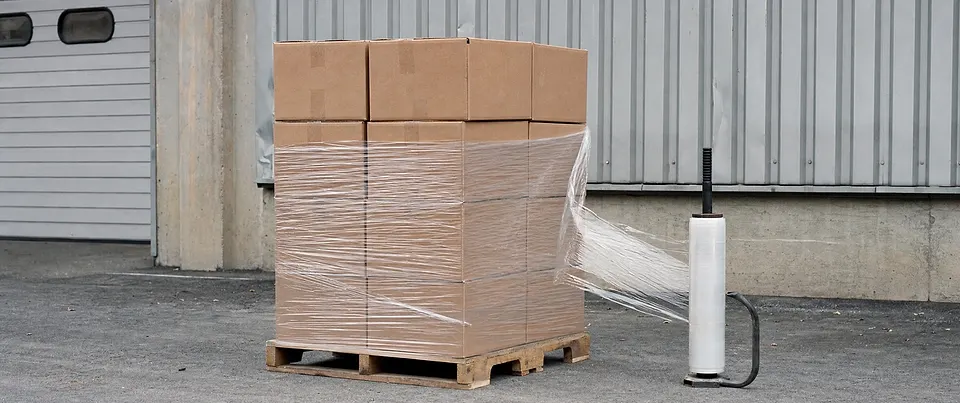
Pre-stretched hand film
| What it is | Film stretched at the plant before rolling |
|---|---|
| Sold by | Equivalent gauge, not true thickness |
| Core | 3 in, fits a standard dispenser |
| Pack | By the case |
| Best for | Light, even loads wrapped by hand |
Most of the stretch has been taken out at the plant, so it goes on with little pull and a roll weighs less. A buying guide warns to compare it on its equivalent gauge, the thickness of ordinary film it replaces, not on the gauge of the film itself.1
Why it holds with less film
The machine's trick, done at the plant.
A wrapper with a powered carriage stretches machine film two or three times its length before it touches the load. That is where the film savings on a wrapper come from: one maker of wrappers says the industry moved from 80 gauge to an average around 65, and that 65 gauge film stretched 250 percent is about 26 gauge by the time it is on the pallet.2 Pre-stretched hand film brings some of that to a dock that wraps by hand, where a person manages only about 25 to 100 percent.3
Where it falls short
Not for every load.
With little stretch left in it, pre-stretched film has less give to absorb a knock. Heavy pallets, sharp corners and mixed loads are better in ordinary or blown film at the gauge the chart gives. Try a case on your lightest, squarest loads first and compare film used per pallet.
Who switches to it
Docks where people do the stretching.
The usual buyer is a warehouse that wraps dozens of pallets a day by hand and has no room or budget for a turntable. Operators carry a lighter roll, pull less, and tire less over a shift, and the load gets a more consistent wrap because the stretch was done by a machine at the plant rather than by a tired arm. Retail back rooms, small distribution sites and seasonal operations with temporary staff are other common fits.
Handling and storage
Thinner film, more care.
Because the web is thin, edges nick more easily when a roll is dropped, and a nicked edge tears on every pass. Store cases flat and lift rolls by the core.
Compare roll weight used per pallet against your current film over a week; that is the real saving.
Questions buyers ask
- Will pre-stretched film hold my heaviest pallets?
- Not usually. With most of its stretch used up at the plant, it has little give to absorb a sudden stop. Keep ordinary or blown film for heavy and sharp loads, and use pre-stretched where loads are light and square.
- Why is the roll so much lighter?
- Because the film is thinner than the gauge it is sold against. A roll of pre-stretched film carries more feet for its weight, which is the point: less to lift, less to carry round the pallet.
- Does it need a special dispenser?
- No. It goes on a standard 3 inch core dispenser or by hand. The difference is in how you pull: it needs much less tension, and over-pulling can neck it down into a rope.
- Does it work on a turntable?
- It isn't made for one. Wrappers stretch film themselves, so they need ordinary machine rolls with stretch left in them.
- Is pre-stretched film easier to tear by accident?
- Its thin web tears more readily at a snag, which is why it suits smooth, square loads; on a rough load, the tear runs.
Related rolls
Gauge, mil and micron
True vs equivalent gaugeHow to compare a pre-stretched roll with the one you use now.
Sources
- AAA Polymer, "A guide to buying stretch wrap film" (reviewed 2026-11-13)
- Lantech, "Blown vs. cast: how is stretch film made?" (reviewed 2026-11-13)
- Colony Packaging, "4 differences between stretch film and shrink film" (reviewed 2026-11-13)
Facts on this page last reviewed 2026-11-13.
Ask for a stretch film quote
Tell us the roll you use now, and we will quote a pre-stretched one alongside it.
- Step 1 asks what you need, how much a month, the delivery ZIP and how to reach you
- Step 2 asks the film, the width and the gauge; skip what you don't know