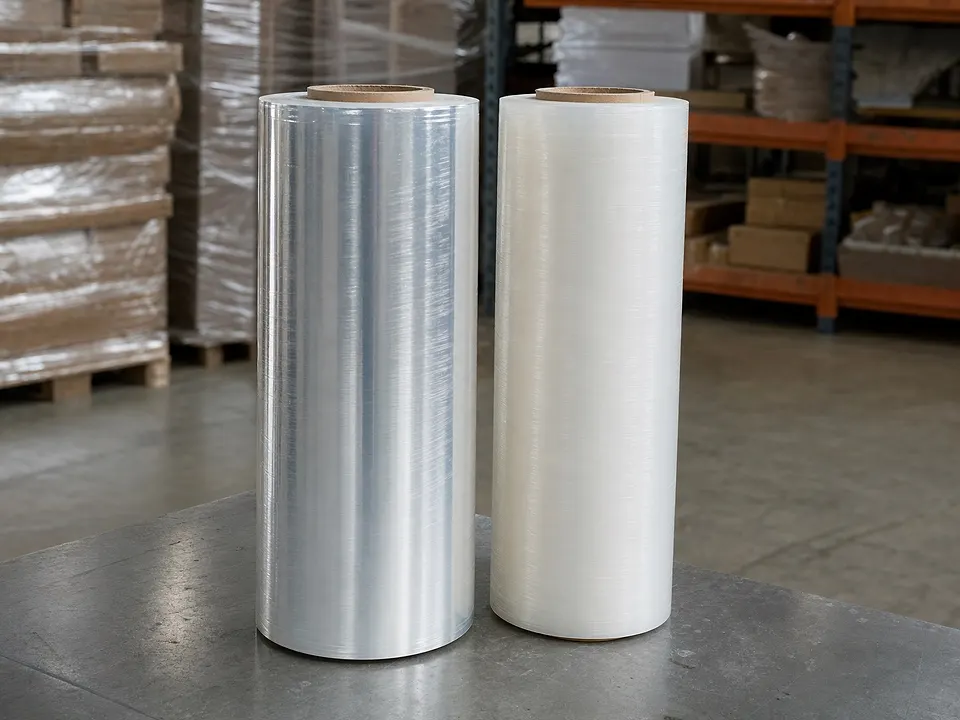
Blown stretch film
| Made | Blown upward as a tube of air, cooled by air |
|---|---|
| Hand roll | 18 in x 1,500 ft x 80 ga · 3 in core · 4 a case |
| Machine roll | 20 in and wider, quoted to your carriage |
| Cling | Strong |
| Share of film made | About 20 to 30% |
Blown film is louder off the roll and a little hazy, but it takes a sharp corner without tearing and holds a load that wants to move.1 The 18 inch, 80 gauge hand roll in one listing comes four to a case on a 3 inch core.2
Loads that want blown film
Irregular, sharp, heavy, or all three.
A buying guide sends irregular loads to blown film.3 That means mixed cartons that don't stack square, drums and pails, bundled metal, parts in totes with edges, and anything that has to survive a forklift tine. The film's toughness is what it is sold on: it stretches round an edge where cast film would start a tear.
What you give up
Noise and clarity.
Blown film is noisier to unwind, which some wrapping halls notice. It is less clear, so a label under three layers is harder to read. And because blown is the smaller share of film made, about 20 to 30 percent,1 it is quoted on its own terms. If your loads are square cases of one product, cast will usually do the same job.
Blown film by hand
Why hand docks like it.
Hand wrappers rarely stretch film far, so the qualities that matter are the ones that work at low stretch: grip on the load, a tail that stays put without tucking twice, and a web that doesn't split when the roll catches a carton corner. Blown film does well on all three. That is why many mixed-load docks, such as grocery distributors, building suppliers and parts warehouses, keep blown hand rolls even though their machines run cast.
Machine rolls in blown
Fewer, but available.
Blown machine rolls are made in the usual 20 inch width and wider. They suit wrappers handling mixed products, sharp loads or cold rooms, where breaks on cast film cost more in downtime than the difference in film price. Ask for the stretch rating, since blown films often run at somewhat lower pre-stretch than cast.
Blown film's toughness is useful in freezers and chillers, where film is stiffer and tears more easily.
Questions buyers ask
- Why is blown film so loud?
- The way it is made, cooled slowly as a bubble, gives it a different surface and structure; it crackles off the roll. It is a nuisance in some wrapping halls and nothing more.
- Is blown film the same price as cast?
- We don't publish prices; ask for both in the request and compare them on the loads each one wraps, not on price per roll alone.
- Do I need a heavier gauge in blown film?
- Often the reverse: blown film's toughness can let you hold a sharp load at the same gauge where cast would tear. Start at the gauge the chart gives and test.
- Which gauges does blown come in?
- From light to heavy, by hand and by machine. It is chosen most often at the heavier steps, where puncture resistance earns its price.
- Is blown film more stretchy?
- Usually a little less, but tougher.
Related rolls
Sources
- Lantech, "Blown vs. cast: how is stretch film made?" (reviewed 2026-11-13)
- Interplas, 18 in x 1,500 ft x 80 ga blown hand stretch wrap (product listing) (reviewed 2026-11-13)
- Uline, stretch wrap guides (reviewed 2026-11-13)
Facts on this page last reviewed 2026-11-13.
Ask for a stretch film quote
Describe what makes the load awkward: corners, height, mixed cartons. We will quote the blown film and gauge for it.
- Step 1 asks what you need, how much a month, the delivery ZIP and how to reach you
- Step 2 asks the film, the width and the gauge; skip what you don't know