Pallet shrink wrap, explained
The clear film holding a pallet of cartons together is stretch film, wrapped tight by hand or by a turntable wrapper, with no heat. True shrink film on a pallet means a cover pulled over the load and shrunk with a heat gun.1
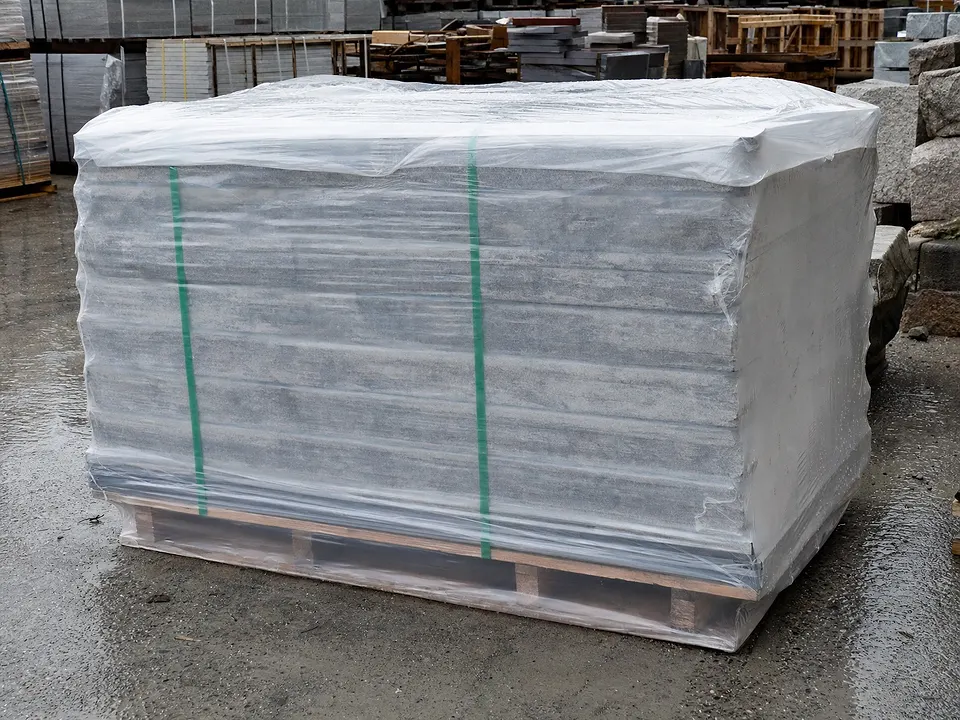
What actually holds a pallet
Stretch film is pulled tighter than its resting length as it goes on, and it tries to spring back. That pull, layer on layer, is what squeezes cartons into one block. A hand wrapper gets 25 to 100 percent stretch; a machine with a powered carriage, 150 to 350 percent.2 The total squeeze is called containment force, and it is what the trade measures, at the top, middle and bottom of a load.3
No heat is involved at any point, which is why stretch film is used on almost every pallet that leaves a warehouse. A dispenser costs little and a wrapper is a once-only purchase;1 a heat gun or tunnel adds a step most docks don't need.
Where shrink film belongs on a pallet
Shrink film earns its place as a pallet cover: a bag of film pulled down over the load and shrunk tight with heat. It seals the top and four sides, which keeps out rain, dust and prying hands. Loads that sit outside for a long time, or that must arrive visibly untouched, are candidates. Shrink pallet covers goes into when that is worth the heat.
Picking the stretch film
Start from load weight. A published buying guide gives 63 gauge for loads up to 2,200 pounds, 70 to 80 gauge for 2,200 to 2,400, 90 gauge up to 2,600, and 100 to 115 gauge for 3,000 pounds and more.5 Then choose cast film for square, uniform loads and blown for sharp or irregular ones. If you wrap by hand, buy hand rolls by the case; on a wrapper, machine rolls by the pallet.
Questions from people who asked for shrink
"Our old supplier called it shrink wrap." Plenty do. Check the case label: if it gives a width, a length and a gauge and the roll fits a dispenser, it is stretch film, and that spec line is all we need to quote it.
"We want it tighter, so we need shrink." Usually not. A loose wrap is fixed with more stretch, more turns, firmer base and top wraps, or a heavier gauge. Measure containment force before buying heat equipment.
"We need to keep rain off." A top sheet under the stretch wrap, or a sealed shrink cover for long outdoor storage. The first is cheaper and faster for loads that are inside within days.
"Our customer insists on shrink wrapped pallets." Ask what they mean. Many write "shrink wrapped" on a routing guide and mean any clear film. If they really mean a sealed cover, that is a different product and needs heat.
Why it matters to get it right
One wrapper maker, Lantech, says about half of in-transit product damage has ineffective stretch wrapping as its root cause.4 That is a machine maker's figure, and it sells machines; but nobody on a receiving dock will argue that a badly wrapped pallet arrives well. The right film, wrapped the right way, is cheap insurance.
Stretch hoods
One system sits between the two: a stretch hood, a tube of thick stretch film that a machine opens, stretches over the pallet and releases so it grips the load on five sides. No heat is used, and the result looks like a shrink cover. Hooding lines are expensive and used mainly by high-volume producers of building materials, bagged goods and beverages. They take their own film, which is not sold as ordinary stretch rolls.
Choosing for the receiving end
Ask how the customer unpacks. Some prefer stretch film because it is quick to remove and recycle; others want sealed loads.
When a heavy-duty stretch wrap is the answer
Loads that tempt people towards shrink because they seem to need something stronger usually need blown film at a heavier gauge, corner boards and firmer base turns.
Banding instead of film
Some heavy, uniform loads, bricks or lumber for example, are held by steel or plastic straps alone, with film added only to keep them clean or dry. Strapping and film complement each other: the straps carry the weight, and a few turns of light film keep rain, dust and loose pieces where they belong.
Questions readers ask
- Do pallets wrapped in stretch film pass carrier inspections?
- Carriers want loads secured so they don't shift or spill. A well-wrapped pallet with base and top turns does that; a loose wrap invites refusal or a damage claim.
- Is there a standard number of wraps for freight?
- Not a single one. Carriers and shippers set their own guidance; containment force testing is how you know a wrap is enough.
- Do we need to label the film?
- Shipping labels go on the load, ideally on two sides, outside the film or readable through clear film.
Sources
- Industrial Packaging, "Difference between shrink and stretch film" (reviewed 2026-11-13)
- Colony Packaging, "4 differences between stretch film and shrink film" (reviewed 2026-11-13)
- Lantech, "Use the force: containment force is the key to safe pallet loads" (reviewed 2026-11-13)
- Lantech (a stretch wrapper maker), lantech.com (reviewed 2026-11-13)
- AAA Polymer, "A guide to buying stretch wrap film" (reviewed 2026-11-13)
Facts on this page last reviewed 2026-11-13.