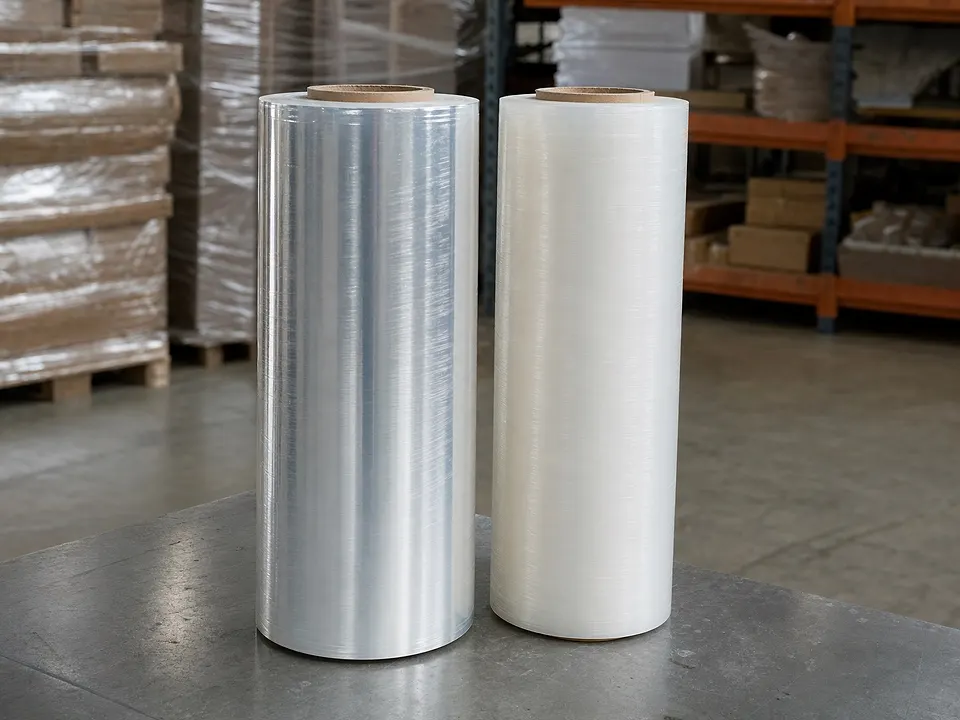
Cast stretch film
| Made | Extruded through a flat die onto chilled rollers |
|---|---|
| Hand roll | 18 in x 1,500 ft · 3 in core |
| Machine roll | 20 in x 5,000 ft x 80 ga · 3 in core |
| Cling | One side or both |
| Share of film made | About 70 to 80% |
Cast film unwinds quietly and you can read a label through it. Its thickness is even across the web, so it stretches predictably on a powered carriage and goes on the same way every turn.1
Where cast is the better film
Square loads, and anywhere a label must be read.
Good at
- Uniform loads: cases of the same size stacked square. A buying guide recommends cast for these.2
- Scanning and checking: clear enough to read a barcode or a count sheet through the film.
- Quiet wrapping halls: it doesn't crackle off the roll.
- Machine wrapping: one listed 80 gauge cast roll stretches up to 250 percent on a powered carriage.3
Where blown does better
- Sharp corners, angle iron, protruding parts: blown resists puncture and tearing better.1
- Mixed and irregular loads that shift: blown has more cling and holding power.
- Outdoor or rough handling: tougher film takes more knocks.
Hand or machine
Same film, two rolls.
Cast comes as hand rolls by the case and as machine rolls by the pallet. The common hand roll is 18 inches by 1,500 feet; the common machine roll is 20 inches by 5,000 feet.3 Pick the gauge from the load, using the gauge chart, then the roll from how you wrap.
Telling cast from blown
Without the case label.
Unwind a length and listen: cast comes off the roll with a soft hiss, blown with a crackle. Hold it up to the light: cast is glass-clear, blown slightly milky. Stretch a strip by hand: cast thins evenly, blown fights back a little more and clings harder to your glove. None of these is a lab test, but together they settle which film a dock has been using when the old cases have gone and nobody kept the spec line.
Cling on one side or both
Which to choose.
One-sided cling film grips itself but has a slick outer face, so wrapped pallets slide past each other in a trailer instead of sticking together, and dust doesn't collect on the outside. Two-sided cling holds a tail better and suits hand wrapping. Many machine rolls are one-sided for that reason.
Clarity and inspection
Seeing the load.
Customs officers, auditors and receivers can check a cast-wrapped pallet's contents and seals without cutting it open.
Questions buyers ask
- Is cast film weaker than blown?
- Not weaker, different. It holds square loads well and stretches predictably; it is less forgiving of sharp points. Choose by the load.
- Why is cast so common?
- Because most pallets are square loads of cases, and cast suits them: clear, quiet, even. One wrapper maker estimates cast at 70 to 80 percent of film made.
- Can I read barcodes through it?
- Usually, through a layer or two of clear cast film. Through many layers, or tinted or opaque film, put the label on the outside after wrapping.
- Is cast film better beside offices?
- Its quiet unwind is one reason sites with wrapping areas next to offices or call centres prefer it.
Related rolls
Sources
- Lantech, "Blown vs. cast: how is stretch film made?" (reviewed 2026-11-13)
- Uline, stretch wrap guides (reviewed 2026-11-13)
- Uline, machine-length cast stretch film, 80 gauge, 20 in x 5,000 ft (product listing) (reviewed 2026-11-13)
Facts on this page last reviewed 2026-11-13.
Ask for a stretch film quote
Name the size and gauge, and whether you wrap by hand or on a wrapper.
- Step 1 asks what you need, how much a month, the delivery ZIP and how to reach you
- Step 2 asks the film, the width and the gauge; skip what you don't know